
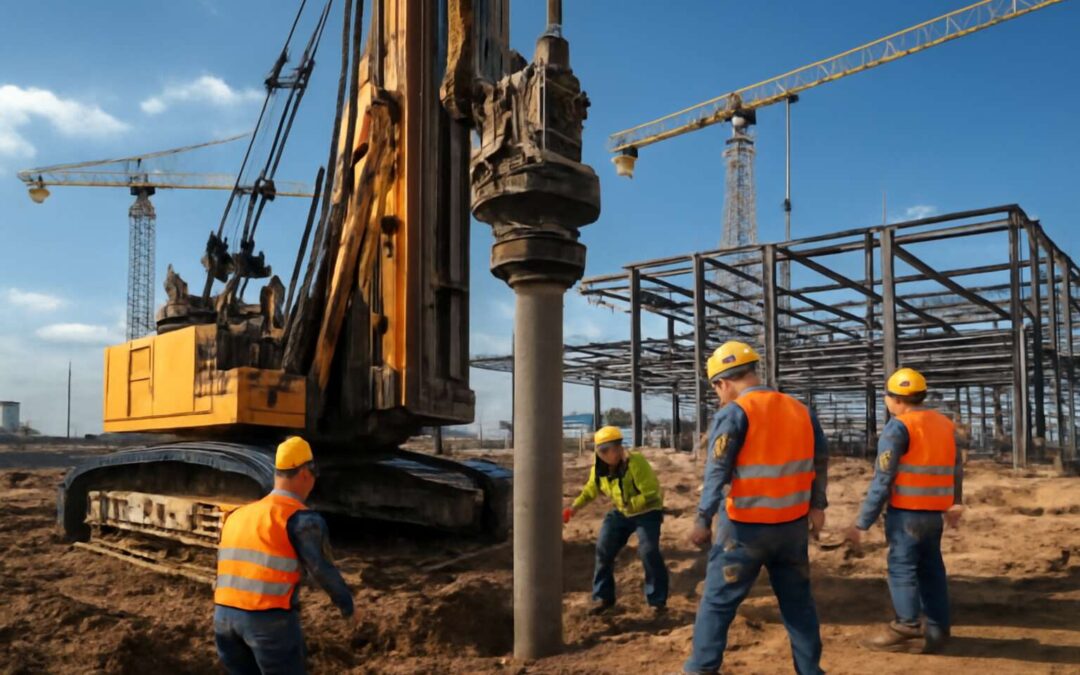
Understanding the role of piling contractors
What piling contractors do on a typical project
Across South Africa’s construction sites, foundation issues can swallow up to 15% of a project budget. That’s a blunt reminder that the subterranean part of building matters as much as the façade. So, what do piling contractors do on a typical project?
These specialists interpret soil reports, coordinate with engineers, and select the piling system—driven, bored, or CFA—best suited to the ground and load.
- Site assessment and soil testing to determine bearing capacity.
- Pile installation, alignment, and load testing to verify performance.
- Documentation and reporting to ensure compliance with local standards.
Foundations must endure local conditions from coastal moisture to heavy urban loads. Piling contractors manage safety, quality control, and coordination with other trades to keep projects moving. That is the role and rhythm behind the noise of concrete and steel.
Key responsibilities in site assessment and planning
Across South Africa’s construction sites, the question what do piling contractors do? They translate soil realities into a plan you can build around. In the early phases, the focus is site assessment and planning: spotting constraints, weighing risks, and coordinating with engineers to shape a foundation strategy. This is where a project finds its backbone—ground truth meeting design intent, from the first sketch to the first pour!
To keep the process cohesive, a few core responsibilities guide every decision:
- Strategic site assessment and planning that aligns with schedule and budget
- Engineering coordination and design integration
- Compliance, documentation, and safety oversight
Selecting and applying piling methods based on geotechnical data
“The ground speaks before the blueprint.” In South Africa’s varied soils, geotechnical data tells a foundation story well before the first pour, and the lesson is crisp: what do piling contractors do when soil realities dictate the method?
Choosing a method isn’t guesswork. It rests on soil strength, stiffness, groundwater, and vibration limits gleaned from borehole logs and tests. Based on that data, the team may lean toward one of these approaches:
- Bored piles (cast-in-situ) for variable soils and high axial loads
- CFA piles (continuous flight auger) for rapid installation in firm layers
- Driven piles for good end-bearing in rocky or dense strata
- Micropiles for underpinning and constrained sites
In practice, the role blends engineering judgment with on-site coordination—ensuring the selected method aligns with project constraints, safety, and long-term performance!
Coordination with engineers, architects, and builders
Across South Africa’s construction sites, coordination is the quiet engine behind every solid foundation. “Coordination is the quiet engine behind every solid foundation,” a veteran engineer likes to say. This is the moment to answer what do piling contractors do: they translate intent into action, weaving engineers, architects, and builders into one chorus. I’ve watched briefs become steel as teams align schedules, resolve clashes, and keep the project humming in harmony!
On the ground, the role is conversational and precise: daily briefings, risk checks, and your safety plan woven into the morning roll call. The magic lies in turning drawings into practice—checking tolerances, sequencing pours, and ensuring that every pile aligns with the design while staying nimble for weather, site access, or material delays.
- Engineering intent translation
- Construction sequencing
- Compliance and safety alignment
Safety, compliance, and quality control on site
On South Africa’s sites, safety isn’t a nicety—it’s the gravity that keeps every concrete sleeve honest. A veteran foreman likes to say, “Safety is the scaffold, not the afterthought.” So, what do piling contractors do? They translate design intent into action while weaving safety, compliance, and quality control into daily rhythm on site. I’ve watched piles go from sketches to solid columns because the crew treats risk checks like weather forecasts—always consulted, never ignored.
On site, the trifecta of safety, compliance, and quality control shapes every move. It isn’t drama; it’s discipline—keeping people safe, permits in order, and joints perfect. We lean on risk registers, daily briefings, and verifications that assemblies meet the design tolerances before any soil yields to steel.
- Comprehensive safety plans and daily risk briefings
- Adherence to codes, permits, and material traceability
- Quality control with pile integrity tests and design-tolerance checks
Piling methods and technologies
Driven piles and precast concrete piles
Foundations don’t forgive hurry; the ground remembers. In South Africa, piling methods and technologies are chosen to match soil truth. Driven piles—steel or timber—are hammered or vibrated to their resting point, forming a solid line into the earth. Precast concrete piles arrive on site as precision units, then are driven or socketed to transfer load cleanly. Each option resonates with the ground’s temperament and history.
Key distinctions emerge in practice:
- Consistent quality control with off-site casting
- Faster installation and reduced on-site curing time
- Effective load transfer through engineered connections
Ultimately, what do piling contractors do? They translate earth’s memory into a frame that lasts—a quiet, relentless mathematics of resistance, where patience guards every beam.
Bored and drilled shafts for deep foundations
Deep foundations in South Africa’s varied soils rely on bored and drilled shafts—long, precise holes that become solid, load-sharing columns. From my experience on sites across Cape Town to Johannesburg, these shafts are drilled with respect for groundwater and soil layering, then lined with casing as needed. On sites where vibration is risky or noise is restricted, bored shafts offer cleaner installation. So, what do piling contractors do in practice with bored shafts? They translate geotechnical data into a controlled hole, install steel reinforcement, and pour concrete with careful curing to form a continuous load path.
Key considerations include:
- Groundwater management and spoil control
- Temporary casing and drilling fluid management
- Reinforcement detailing and concrete placement discipline
These shafts anchor structures with a quiet arithmetic of resistance, matching the ground’s memory to the frame above.
Continuous flight auger and CFA piling techniques
On busy SA sites, CFA piling can shave weeks off timelines—up to 25% faster on constrained urban plots. So, what do piling contractors do on these jobs? They drive a hollow-stem auger, steadily inject grout, and form a continuous, load-bearing column with minimal vibration.
As the auger advances, reinforcement cages are positioned to spec, and pumping control keeps grout quality high and consistency uniform. The approach suits restricted vibration zones and variable soils, turning a noisy process into a measured, almost surgical operation.
Key advantages include:
- Low vibration and quiet operation
- Continuous concrete that speeds installation
- Reduced spoil and simpler logistics
- Adaptability to soil changes without losing alignment
In practice, what do piling contractors do? They manage depth and eccentricity, monitor grout pressure, place cages, and coordinate with engineers—delivering CFA piles that quietly carry the building frame.
Micropiles and mini piles for restricted spaces
On tight plots, what do piling contractors do to keep foundations reliable without heavy disruption? Micropiles and mini piles step into the foreground—small-diameter, drilled columns grout-filled and anchored to rock or soil strata. They descend with minimal vibration, can be installed from limited access points, and adapt to uneven basement footprints or existing structures. In SA’s dense urban fabrics, such methods unlock basements and lift lines without the noise of larger rigs.
- Small footprint and access from restricted points
- Rapid installation with precise alignment
- Low vibration, reduced nuisance on neighbours
Engineers specify tailored grout mixes and reinforcement strategies, allowing these piles to carry stubborn loads with grace. They blend the rigour of geotechnical insight with practical, on-site finesse—turning constrained spaces into reliable foundations where every centimeter matters.
Specialty piles for challenging soils and load conditions
Hybrid and innovative piling solutions
Foundations set the tempo of any build—and in South Africa’s varied soils, that tempo is often unpredictable. In the field, what do piling contractors do? They blend methods and technologies to keep loads safe while cutting disruption on site. A few clever hybrid approaches let crews switch between augering, jetting, and driving, without stopping for lengthy swaps. The result is faster installation, gentler vibration, and reliable load transfer across diverse ground.
Hybrid and innovative piling solutions are not one-size-fits-all. Here are a few approaches gaining traction:
- Modular rigs that combine driving and drilling for flexible soil profiles
- Steel-encased or composite piles blending strength with rapid installation
- Jet-grout and soil stabilization integrated with pile construction
Smart monitoring and design collaboration drive these methods, ensuring safety, compliance, and longer service life. With engineers and builders coordinating from a shared digital model, piling becomes a visible, trackable process rather than a black box.
Project planning and site preparation
Geotechnical investigations and soil testing
Foundations speak softly—until a building roars to life in South Africa’s urban cores. Industry data shows early geotechnical work can cut foundation delays by up to 40%. The question what do piling contractors do guides every decision on a project, shaping how risks are managed from the ground up.
Project planning and site preparation are where the magic begins. We map access routes for rigs, schedule deliveries to avoid conflicts, and prepare the footprint with precision!
Geotechnical investigations and soil testing anchor every choice. We collect soil samples, interpret groundwater tables, and model how piles will behave under load.
- Site reconnaissance and utility checks
- Soil sampling and lab tests
- Subsurface profiling and borehole logs
Groundwater control and dewatering strategies
Water on a South Africa site is an unspoken clock; the moment it flows where it shouldn’t, schedules slip. So, what do piling contractors do? They choreograph project planning and site preparation with surgical precision, mapping rig access, staging areas, and the footprint to keep the operation tight from day one.
Groundwater control and dewatering strategies form the backbone of dry excavations and stable profiles. They balance risk, cost, and pace instead of letting a water table dictate the schedule.
- Wellpoint or deep-well dewatering options
- Sump arrangements and sediment control
With groundwater managed, the workspace stays dry yet stable. Retaining features and measured pump sequencing help keep nearby structures undisturbed as piles begin to take shape.
Permitting, codes, and regulatory compliance
Across South Africa, regulatory gates can feel like stone guardians guarding a sacred site, and time slips through the cracks. A recent industry briefing notes that permitting and compliance can stretch the prep phase by weeks. So, what do piling contractors do to stay on schedule while honoring the rules?
They approach permitting, codes, and regulatory compliance with a calm, storyteller-like rigor. From local authority liaising to meticulous documentation, they ensure every design decision travels through the proper channels, keeping records auditable and actions traceable. The aim is a seamless regulatory rhythm that supports site reality rather than impeded progress.
On quiet mornings, the paperwork hums in the background while the built environment watches responsibly—neighbors, utilities, and the landscape all kept in balance as the foundations take shape.
Logistics, crane time, and equipment staging
Across South Africa’s bustling skylines, crane time is the metronome of progress; miscount it and the day slips into shadow. In this theatre of soil and steel, what do piling contractors do to keep the rhythm when the ground resists?
They translate the plan into on-site choreography: early site walks, weather windows, and layered logistics that thread permits, deliveries, and crew shifts through a single, steady thread. The focus is on the unseen clockwork that keeps trench blankets and pile rigs aligned.
- Crane time windows and sequencing
- Equipment staging and access paths
- Utility clearance and site traffic management
Equipment arrives as if summoned, every crate and coil sized to a grand plan. When crane time is respected and staging aligns with gate schedules, the work breathes—heavy, deliberate, and inexorably toward dawn.
Scheduling and coordination with other trades
On South Africa’s skyline, 40% of delays trace to mismatched trade schedules. This is the essence of what do piling contractors do: translate blueprints into on-site choreography, turning soil and steel into a singular rhythm that the site breathes with.
- Pre-construction coordination with civil, electrical, and MEP teams to align interfaces
- Integrated schedules that reflect crane time, access paths, and utility clearance
- Delivery windows and gate passes synced with deliveries, permits, and crew shifts
Scheduling and coordination with other trades set the tempo. We map interface points where a bore meets a sleeve, where cranes need a clean arc, and where trades must not collide. The result is a shared calendar that keeps every crane, crew, and vehicle moving in step.
Weather windows, permits, and site traffic drift in and out of view; what do piling contractors do, yet the plan remains, quietly orchestrating precision beneath the dust and dawn.
Quality assurance, safety, and risk management
Load testing, integrity checks, and as-built documentation
Foundations are quiet catalysts that shape a South African skyline. In the world of piling, what do piling contractors do beyond hammering steel and pouring concrete? They weave quality assurance, safety, and risk management into every move—planning, execution, and verification—so projects withstand the test of time and weather. The result is not flash, but assurance you can stand on!
- Load testing and real-time monitoring to confirm capacity under expected service conditions
- Integrity checks on piles, sleeves, couplers, and connections to prevent hidden defects
- As-built documentation that records every variation, measurement, and completion milestone
With these elements, risk is managed, safety is prioritized, and stakeholders gain a traceable record of performance that travels from the field to the boardroom.
Safety protocols, training, and incident reporting
What do piling contractors do? They choreograph quality assurance, safety, and risk management from planning to completion, so projects endure. In South Africa, this means constant vigilance amid changing soils and weather, and a culture that refuses to compromise on safety.
Safety protocols are the first line of defense—clear roles, PPE discipline, and rigorous equipment checks. Training is continuous, with refreshers and drills designed to drill in calm decision-making even under pressure. Incidents are reported, logged, and dissected to drive swift corrective action.
- Pre-job safety planning and risk assessment
- On-site safety briefings, supervision, and permit management
- Incident reporting, root-cause analysis, and corrective action
Quality control during installation and grouting if applicable
Quality assurance, safety, and risk management are not add-ons; they are the compass guiding every decision from plan to pour. On South African sites, the question—what do piling contractors do—reverberates across teams as they harmonize inspection, method, and discipline to weather changing soils and rains with care.
Quality control during installation and grouting sits at the heart of this craft: mix consistency, shaft integrity, and grout flow are tracked with meticulous records, not guesswork. On site, engineers and crews collaborate to verify dimensions, alignments, and reinforcement details before concrete takes its final form.
- Materials qualification and grout mix verification
- In-situ checks and non-destructive testing during installation
- Documentation, traceability, and as-built records
The discipline extends to post-pour performance across South Africa’s landscapes—monitoring settlement, ensuring cap continuity, and maintaining a risk log so any deviation is addressed swiftly, keeping structures steadfast through seasons and soil shifts.
Environmental impact and spoil management
Quality assurance, safety, and risk management guard every South African piling project. I’ve seen them turn shifting soils into disciplined action. In discussions about the trade, what do piling contractors do becomes a question we answer through practice. They weave these disciplines from design reviews to on-site rehearsals, so structures endure our country’s diverse soils!
Environmental impact and spoil management stand beside strength and alignment as non-negotiables. Teams plan spoil minimisation, containment, and careful cleanup; spoils are classified and disposed of through licensed channels. On-site reuse of inert material is pursued when feasible, trimming transport and emissions.
- Containment and erosion control during excavation
- Spoil classification, on-site segregation, and licensed disposal
- Reuse and recycling of excavated material where feasible
Across the lifecycle, a living risk log and meticulous records keep teams honest and ready for the next season.
Common piling challenges and troubleshooting methods
Across South Africa’s busy construction sites, quality assurance, safety, and risk management guard every piling project. “Quality is built into the ground,” says a veteran geotechnical engineer, and that insight informs inspections, design reviews, and on-site rehearsals. That question—what do piling contractors do—shapes decisions before the first drill bit meets soil and marks the foundation for the landscape.
- Real-time QA checks during drilling and grout placement
- Living risk registers and incident reporting protocols
- Independent verification for critical milestones and loads testing
Common challenges include groundwater fluctuations, soil variability, and equipment wear. Troubleshooting hinges on disciplined diagnostics: tightening alignment to design tolerances, calibrating drilling fluids and casing, and updating load-testing plans when readings diverge. A living risk log and meticulous records keep teams honest and ready for the next season.
