
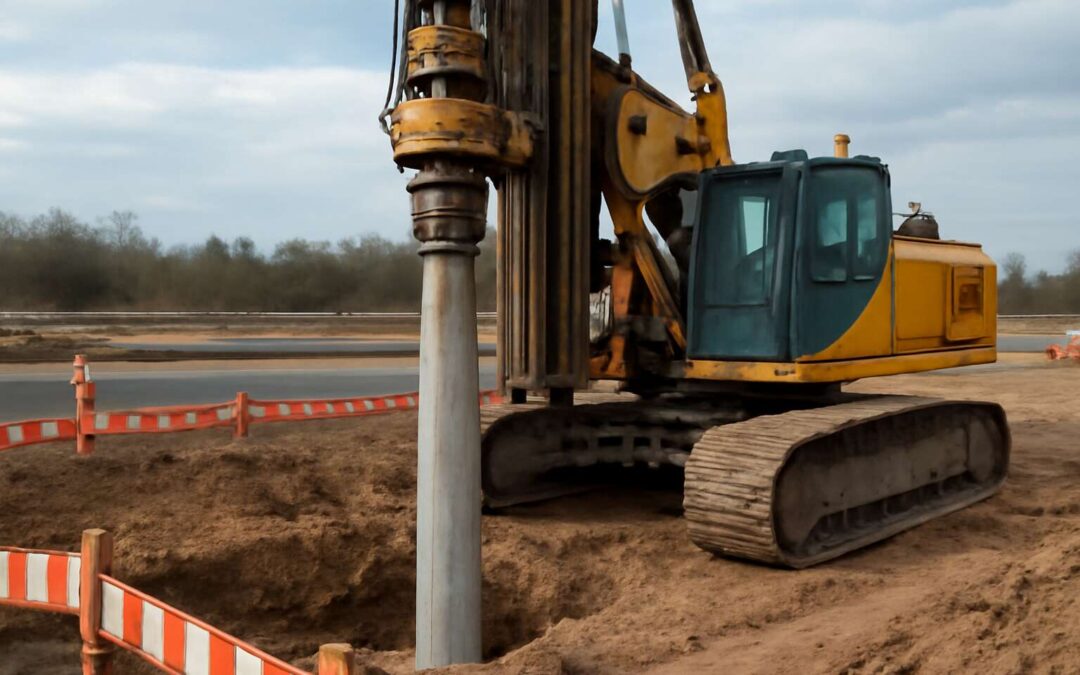
Piling in Road Construction Fundamentals and Applications
What is piling in road construction and why it matters
In South Africa’s vast landscapes and urban sprawl, the ground keeps its own counsel. Piling road construction is the patient art of placing deep columns that anchor asphalt to stable layers, lifting roads above their shadows and weather. The statistic murmurs: roads fail primarily where subsoil fails, a reminder that structure begins below the surface!
Foundations bite into bedrock or hard clay, resisting the sway of heavy trucks and seasonal moisture. Piles transfer load gently yet decisively, a quiet chorus beneath every kilometer of tar and steel.
Applications span the corridor of transport infrastructure. Consider these core uses:
- Supporting railway and road overpasses that cross channels or soft soils
- Stabilizing embankments and foundation for bridges
- Creating resilient road pavements in flood-prone zones
Within the discipline, this craft remains a patient, precise art under the veil of earth!
Common piling methods used in highway projects
The ground writes the first chapter of every road. The truth in the field is that distress arrives from beneath, not from the surface. “The ground is the foundation of movement,” a seasoned engineer reminds us, and their words echo across South Africa.
piling road construction gives asphalt a patient, invisible partner—deep columns bite into bedrock or hard clay and lift pavement above shifting soils. Piles transfer load gradually, distributing stress to stable layers and resisting floods and pressure from heavy traffic.
Common piling methods used in highway projects include:
- Driven piles
- Bored shafts
- CFA piles
In South Africa, this craft underpins transport corridors, enabling safe travel across embankments, bridges, and flood-prone zones. I’ve watched it rise from the ground, a quiet strength keeping lines on the map when the earth itself is asking questions.
How to select pile types for road foundations
The ground is the foundation of movement, a truth that guides every road project. In piling road construction, the pile type you choose governs how the pavement rides out pressure, time, and climate. Ground behavior, load path, and durability shape every core decision on South Africa’s terrain.
- Soil profile and groundwater conditions
- Load magnitude and duration
- Access, footprint, and installation constraints
- Flood, frost, and climate resilience
For many sites, driven piles, bored shafts, and CFA piles offer different paths to stability, chosen from soil data and load considerations.
Benefits, challenges, and typical use cases of piling in transport infrastructure
Roads don’t just carry traffic; they carry a legacy of engineering decisions. A striking stat from the industry suggests substructure issues drive maintenance costs up to 40% in the first decade. In piling road construction, foundations decide how a pavement rides out pressure, time, and climate. Ground behavior, load path, and durability shape every choice on South Africa’s diverse terrain.
Benefits include longer service life, fewer future repairs, and smoother rides. Challenges include variable groundwater, access constraints, and up-front costs. Yet the right piling strategy turns soil data and load demands into durable transport corridors.
Typical use cases in transport infrastructure:
- Highway widening on poor subgrades
- Bridge approaches and interchanges requiring vibration control
- Rapid-installation corridors with heavy traffic during construction
- Coastal and flood-prone routes requiring corrosion-resistant piles
Pile Design and Engineering for Road Projects
Geotechnical assessment and data interpretation for piling
‘The ground reveals more than it hides,’ a seasoned team leader reminds the crew, and in piling road construction, truth travels with every layer. When design meets soil, the road stops being a line and becomes a dialogue with the earth itself. Numbers guide the project, but humility before strata keeps foundations honest!
Pile design and engineering hinge on a robust geotechnical assessment and careful data interpretation. The team translates borehole logs, CPT results, and pore-water pressures into a narrative about stiffness, bearing capacity, and settlement potential—knowing that one misread can ripple along miles of asphalt and steel.
Key data to interpret for piling road construction include the following factors:
- Soil stratigraphy and shear strength
- Groundwater regime and pore pressures
- Pile capacity modeling and safety margins
In the end, design is stewardship—the quiet art of turning geotechnical whispers into long-lasting corridors for movement.
Calculating capacity and safety checks for road piles
In piling road construction, the ground speaks—and the loudest messages arrive as data. “The ground reveals more than it hides,” a seasoned team leader reminds the crew, and this is not poetry; it’s policy. Pile design and engineering hinge on a robust geotechnical assessment, translating stiffness, bearing capacity, and settlement potential into a plan the earth will endorse.
Calculating capacity and safety checks for road piles demands discipline and a clean spreadsheet. The key considerations include:
- Capacity modeling: end-bearing vs friction and model choice.
- Safety margins to keep settlements in check.
- Verification testing, including non-destructive methods.
- Quality documentation for long-term performance.
Pile group optimization and interaction effects
Pile design and engineering for road projects is the heart of piling road construction, where soil dialogue becomes policy. I listen as the ground whispers in numbers as much as in dust and grit. Pile group optimization matters because when piles act in concert, their interaction effects can magnify or mute individual capacity. The design challenge is foreseeing how a crowd of piles shares the load, transfers it to the soil, and keeps settlements honest under traffic, heat, and rain in South Africa.
- Spacing strategies that influence interaction effects
- Load transfer pathways and sequence considerations
- Monitoring data interpretation as a guard against performance issues
All of this rests on a human core—discipline, observation, and the stubborn belief that a road survives by listening to the ground and responding with measured restraint.
Durability, materials standards, and corrosion protection for road piles
Durability is the quiet guardian of our roads, and in piling road construction, design choices set the tempo of performance for decades. A robust pile system must endure sun, moisture, and traffic without surrendering height or strength. The first rule is to align materials with soil truth and climate rhythm.
At the heart of design, materials standards and corrosion protection govern longevity. Builders select concrete grades, steel sleeves, and protective coatings that resist chlorides and sulphates, while ensuring workability and constructability in windy sites across South Africa. The following pillars keep piles standing tall:
- high-quality concrete and cover depths that deter cracking
- galvanic protection, epoxy coatings, and barrier sleeves
- corrosion inhibitors and compatible reinforcement
- correct detailing for drainage, shrinkage, and load transfer
With disciplined execution, monitoring, and respect for soil dialogue, piling road construction endures the desert heat, coastal spray, and the march of daily traffic.
Design considerations for seismic and load combinations
The road hums like a living thing, and every pile is a heartbeat beneath it. In piling road construction, design decisions for South Africa’s diverse climates set the tempo for decades, balancing safety, service, and stubborn sun.
Seismic considerations sculpt the skeleton. We assess soil-structure interaction, dynamic amplification, and pile enclosure behavior under plausible ground motion, then choose pile lengths and group layouts to dampen motion.
Load combinations demand rigor and restraint; the following pillars frame resilient layouts:
- Seismic demand with realistic ground motion
- Live-load and dynamic amplification
- Soil-structure interaction and pile-group effects
Executed with discipline, the design reads like a thriller—every detail counted, every member coordinated, waiting for the next storm!
Construction Techniques and Equipment
Site preparation, shoring, and temporary works for piled foundations
Across South Africa’s stretching corridors, piling road construction begins with earth and intent. A well-placed pile is not a nuisance but a vow; the foundation listens to soil, weather, and weight, then answers with stability and grace.
Site preparation, shoring, and temporary works are the backstage crew: they hold the stage while piles rise. Ground protection, safe access, and controlled dewatering shield both people and pavement from the drama underground.
- shoring systems: sheet piles, struts, and bracing
- temporary cofferdams and dewatering layouts
- access platforms and tie-backs for alignment
Equipment spans from crawler cranes to rotary drills and pile-driving rigs; operators tune vibration, rotation, and impact to soil whispers. In South Africa, varied ground conditions demand careful sequencing, resting the project on accuracy and patience rather than haste.
Driven piles versus bored piles in road construction
Across South Africa’s corridors, piling road construction shapes the backbone of resilient highways. A surprising 60% of new alignments rely on piled foundations to weather soils and seasonal rains. Driven piles rush to set with a hammering certainty, while bored piles are in situ sculptures that bend with variable strata. The choice depends on ground conditions, noise limits, and space—factors that govern speed, cost, and long-term stability!
- Driven piles: rapid installation, strong end-bearing where strata are firm.
- Bored piles: low vibration, adaptable to variable soils.
- Hybrid methods: casing and CFA for complex sites.
Equipment ranges from crawler cranes to rotary drills and vibro rigs used in piling work. Operators tune vibration, rotation, and impact to respect soil whispers and maintain traffic flow—an art as important as the pile itself.
Equipment selection, installation sequence, and safety protocols
On the shadowed arterial of South Africa, piling road construction hums at dawn like a sealed chamber. In my notebook, equipment choices read like a necromancer’s catalog—vibro rigs, CFA drills, rotary cranes—each tuned to the ground’s secret rhythm. The promise is plain: rapid installation that respects traffic and weather while the structure endures. In this theatre, efficiency wears a somber crown.
Key steps in the installation sequence include:
- Rig setup and soil compatibility checks
- Piling execution (driving or drilling) with alignment verification
- Post-installation integrity checks and temporary works handover
Safety protocols—PPE, exclusion zones, vibration control, and traffic management—keep the project breathing as the ground keeps its secrets.
Vibration control and nuisance management during piling
Ground talks in numbers, not whispers. In South Africa’s urban corridors, vibration limits sculpt every move of piling road construction, turning rhythm into responsibility. “The ground speaks in figures; we answer with precision,” says the site lead, watching seismographs!
Techniques center on mitigating dynamic loads: tuned vibro rigs, CFA drills, and rotary drives, paired with real-time monitoring, dampers, and phased sequencing to preserve traffic flow and structural integrity. The aim is to limit nuisance while keeping schedules intact.
- Real-time vibration monitoring
- Barriers and isolation mats
- Community liaison and transparency
Managing nuisance extends beyond equipment. Strategic scheduling, barrier systems, silent nighttime windows, and proactive community liaison turn vibration control into a cooperative art—an essential thread in any road construction narrative.
It reads as a quiet epic: the ground waits, machines listen, and roads emerge with measured restraint and enduring promise. This is how piling road construction endures.
Quality control during pile installation
One precise centimeter can decide the life of a road. In piling road construction, the difference between plan and pavement is traced in early, quiet quality checks; audits show about 83% fewer delays when pile integrity is verified on site.
Techniques converge with equipment quality control: calibrated vibro rigs, torque-controlled drives, and controlled pours. Real-time sensors monitor alignment, verticality, and load transfer, while non-destructive testing confirms pile integrity before the cap is cast.
- Real-time alignment, verticality, and driven-length verification
- Concrete mix quality, slump control, grout integrity, and cure monitoring
- Materials traceability, pile IDs, and pour/drive records
Together, these practices translate science into dependable road foundations, ensuring the transition from bore to cap remains steady under load.
Quality Assurance, Testing, and Compliance
Pile integrity testing methods and interpretation
In piling road construction, the true cost of silence is paid later, when a quiet flaw becomes a loud maintenance bill. A crisp truth guides every job: pile integrity testing that catches flaws early saves millions and prolongs highway life.
Quality Assurance relies on rigorous testing and compliant interpretation. Non-destructive methods reveal hidden defects without delaying progress. Tests are planned, executed with traceable equipment, and logged into a formal QA record that supports accountability within SA regulatory expectations.
Common methods include:
- Low-strain dynamic pile testing (PIT)
- Sonic Echo/Pulse Echo testing
- Crosshole Sonic Logging (CSL)
- Ground-penetrating radar (GPR) for near-surface anomalies
- CAPWAP interpretation of dynamic data
Interpreting results against codes, maintaining records, and ensuring traceability anchors quality across SA road projects.
Dynamic and static load testing for verification
In piling road construction, the cost of silence is paid later—hidden flaws magnify into maintenance bills that outlive pavements. Quality Assurance is not a ritual; it’s the quiet engineer that frames every pour and every probe. A telling SA statistic puts lifecycle costs higher by up to 25% when QA gaps allow defects to slip through.
Dynamic and static load testing provide verification by exposing how piles respond to real and simulated loads. Tests are planned with traceable equipment and logged into a formal QA record that supports accountability within SA regulatory expectations. In this field, compliance underpins confidence and turns data into a backbone for safety.
- traceability of materials and loads
- calibration and audit trails for testing gear
- document control aligned with SA standards
Non-destructive testing and inspection regimes
In piling road construction, QA isn’t a ritual; it’s the quiet engineer who makes every pour trustworthy and every probe meaningful. SA data shows lifecycle costs can rise by up to 25% when QA gaps let defects slip through—a price paid long after the road is laid. Non-destructive testing and inspection regimes guard against hidden flaws, turning risk into a measurable metric.
Quality assurance rests on traceability of materials and loads, calibration and audit trails for testing gear, and document control aligned with SA standards. This is the backbone that turns data into safety.
- Visual and surface inspections
- Non-destructive testing regimes (ultrasonic, magnetic particle, and radiography) to reveal hidden flaws
- Pile integrity checks and cross-hole sonic logging
- Calibration and audit trails for test equipment
Compliance remains a lighthouse, guiding every pour and every probe toward enduring pavements.
Documentation, standards, and regulatory compliance
Across SA projects, lifecycle costs rise by as much as 25% when QA gaps let defects slip through. Quality Assurance in piling road construction is not a ritual—it’s the quiet engineer I trust to keep every pour trustworthy and every probe meaningful! In South Africa, a single unchecked flaw can echo through decades of maintenance and road user costs, so each pour demands disciplined observation.
We anchor QA in traceability—materials, loads, and test results carry transparent provenance. Calibration and audit trails for equipment ensure gauges and sensors never become guesses, and document control aligned with SA standards keeps every record legible to auditors and authorities.
Key elements of a robust compliance regime include:
- Material and load traceability
- Calibration logs and equipment audits
- Documentation aligned with South African regulatory standards
Environmental monitoring and mitigation measures
Quality Assurance in piling road construction is not a ritual; it is the quiet engineer that keeps every pour trustworthy and every probe meaningful. Across South Africa, lifecycle costs rise by as much as 25% when QA gaps let defects slip through.
Testing, calibration, and documentation knit compliance into daily practice. Environmental monitoring and mitigation measures include:
- Air quality and dust suppression plans
- Groundwater and surface water protection through targeted sampling
- Vibration monitoring and nuisance mitigation for nearby communities
- Noise control during piling operations and scheduling
- Waste management, spill response, and site restoration protocols
- Soil protection and ecological rehabilitation where necessary
Real-time data and periodic audits translate into safeguards that endure decades of roads and traffic—the ledger of trust written in concrete and data.
Project Planning, Risks, and Cost Considerations
Scheduling, logistics, and coordination with adjacent works
In piling road construction, robust project planning is the quiet engine that keeps crews aligned and timelines honest—data from South African projects show disciplined schedules finish on time far more often! A crisp master schedule and clear interfaces prevent the project from slipping into the abyss of rework and claims.
Risks and cost considerations demand a nimble mindset. A living risk register illuminates cost drivers—mobilisation, site access, and utility diversions—while contingency budgeting cushions the unexpected without turning the books into a thriller.
Scheduling, logistics, and coordination with adjacent works require meticulous synchronization: traffic management, crane and pile rig availability, and environmental controls. When interfaces clash, the whole corridor slows; when they align, progress looks almost effortless—precisely the kind of efficiency South Africans expect during peak-hour commutes!
To keep momentum, coordinate on:
- Defining responsibilities and handoffs
- Aligning permits, inspections, and utility digs
- Building buffer windows for weather and access
Risk management strategies for piling operations
In piling road construction, the quiet engine is a master risk register—without it, budgets wander off like traffic at peak hour. A crisp master schedule keeps crews aligned and interfaces tidy; “Plan the risk, or risk the plan,” a veteran notes, shows risk visibility as stealth fuel that keeps progress from stuttering.
Risk management and cost considerations hinge on a living plan, a habit South Africa’s builders know well. The big drivers—mobilisation, site access, and utility diversions—shine a light on where money hides, while contingency budgeting cushions the unexpected without turning numbers into theatre.
- Dynamic ownership of the risk register across teams
- Interface clarity with adjacent works and utilities
- Contingency buffers aligned with plausible cost scenarios
- Transparency in traffic management and environmental constraints
Cost drivers and budgeting for road pile foundations
Budget overruns on road projects aren’t fate; they’re a math problem. In piling road construction, a living cost plan keeps the wheels turning, slashing double-digit overruns and stopping the schedule from stalling. When numbers breathe, progress doesn’t stutter like a tired grader.
Risks reveal themselves in interfaces and unexpected shifts. With clear ownership across teams and steady dialogue with adjacent works, risk becomes a manageable cost lever rather than a ghost on the job site.
- Mobilisation and logistics
- Site access constraints
- Utility diversions
Contingency buffers must mirror plausible cost scenarios; SA builders know that a cushion in the budget is cheaper than misplaced courage when piles meet hard rock. Transparent traffic management and environmental constraints keep the entire corridor honest and on schedule for piling road construction.
Contractual frameworks and procurement strategies for piling
From the first soil bite to the crown of the finishing ribbon, project planning in piling road construction is the compass that keeps us true. In South Africa, planning gaps drive overruns, a stat I’ve witnessed on many corridors. We lock milestones and map the supply chain before the first pile sinks.
- Milestone scheduling with float
- Interface governance agreements
- Supply chain mapping and lead-item risk
Risks reveal themselves at interfaces and in unexpected shifts. A living risk register, with steady dialogue across disciplines, turns threats into cost levers rather than ghosts on site. Ground conditions, weather windows, and permit timing shape contingency.
Contractual frameworks and procurement strategies anchor the piling program to reality. In SA, models—open tender with early involvement, design-build, alliance—shape risk sharing, payment triggers, and performance expectations.
- Open tender with early involvement
- Design-build integration
- Alliance contracting with shared risk
